Grade LevelHigh School |
TopicsPhysics |
AuthorsChima McGruder, Bonnie Tate |
Lesson Summary
This lesson helps students understand how using both a wave model and particle model of electromagnetic radiation can be used to collect and interpret the transmission spectra of a planet’s atmosphere.
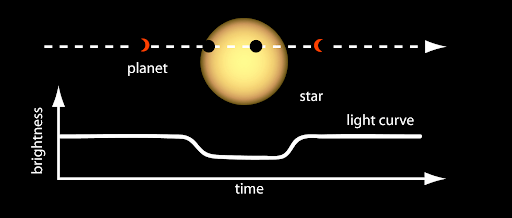
Upon completion of this lesson, students will be able to:
- use the EM spectrum and a mathematical model to relate wavelength, frequency, energy and color.
- describe how astronomers use both the wave and particle nature of light to make observations of exoplanet atmosphere.
- describe the relationship between the absorption of specific wavelengths of light by a planet’s atmosphere and what types of molecules are in the planet’s atmosphere.
Standards
Science and Engineering Practices:
SP2MA Science and Technology/Engineering (2016):
HS-PS4-1, HS-PS4-3, HS-PS4-5NGSS (2013):
HS-PS4-1, HS-PS4-3Common Core Math/Language Arts Standards:
Tags
absorption, diffraction, dispersion, electromagnetic spectrum, energy, exoplanet, frequency, light curve, photoelectric effect, photon, spectrometer, spectroscopy, transmission spectroscopy, transmitted, wave-particle duality of light, wavelengthEducator SoundBites
Feedback coming soon!
Lesson Documents
Bite
Student
Educator
Feedback
Let us know what you think of this lesson!